 StockPets
STORIES FROM THE FARM
The Rule of 72: How Long Does It Take Money to Double?
· The StockPets team
Compound growth is easy to describe and hard to feel: returns start earning returns of their own. The rule of 72 turns that idea into mental arithmetic you can do in a second — and knowing where it stops working is just as useful.
Short answer
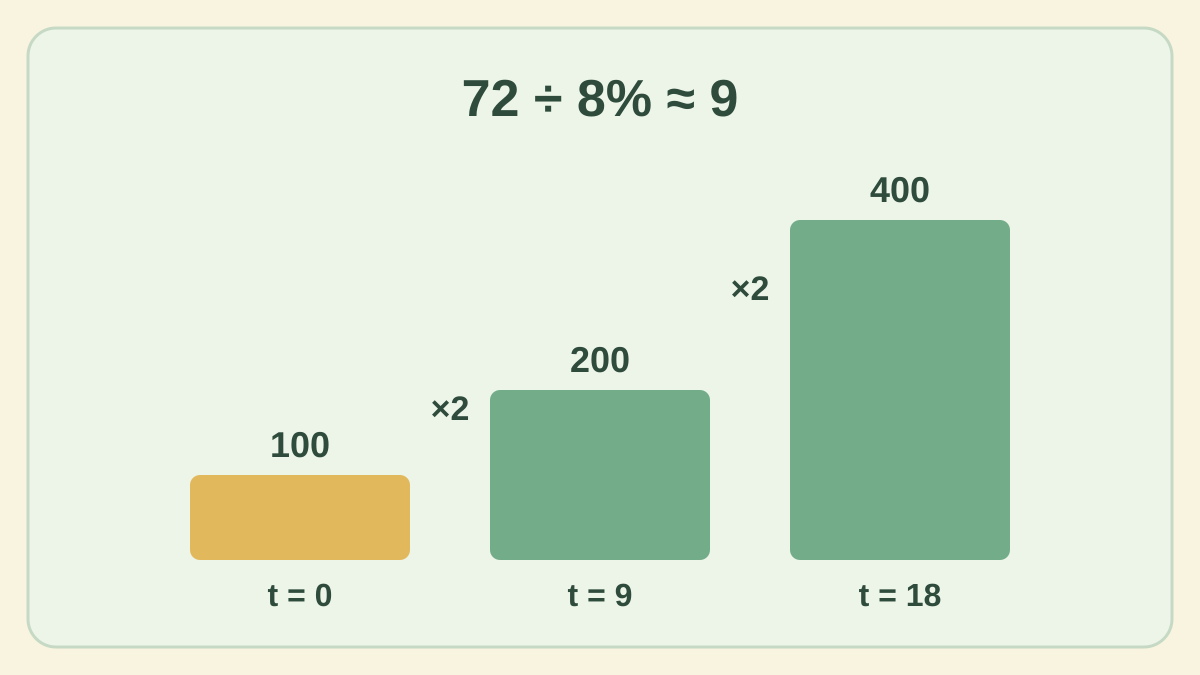
Divide 72 by the annual growth rate in percent to estimate the years needed to double: at 8%, 72 ÷ 8 = 9 years (the exact answer is 9.01). The precise formula is ln 2 ÷ ln(1 + r). The shortcut assumes a steady rate; real markets rise and fall, and losses slow compounding down. In StockPets one turn is one month, so the same idea works per turn: a crop growing 1% a month doubles in about 70 turns.
What is compound growth?
With simple interest you earn the same amount every year, because the rate is always applied to the original sum. With compound growth, each period’s gain is added to the base, so the next period’s percentage applies to a bigger number. 100 growing 10% a year becomes 110, then 121, then 133.1 — the extra 1 and 2.1 are gains on earlier gains.
Over a few years the difference looks tiny. Over decades it dominates: at 10% a year for 30 years, simple interest turns 100 into 400, while compounding turns it into about 1,745.
How does the rule of 72 work?
The exact doubling time is ln 2 ÷ ln(1 + r), where r is the rate written as a decimal. For everyday rates that comes out close to 72 ÷ the rate in percent. The number 72 is popular because it divides neatly by 2, 3, 4, 6, 8, 9 and 12, and because it slightly offsets the approximation error in the middle range of rates.
| Annual rate | Rule of 72 (years) | Exact (years) |
|---|---|---|
| 2% | 36 | 35.00 |
| 3% | 24 | 23.45 |
| 4% | 18 | 17.67 |
| 6% | 12 | 11.90 |
| 8% | 9 | 9.01 |
| 10% | 7.2 | 7.27 |
| 12% | 6 | 6.12 |
| 24% | 3 | 3.22 |
The rule is closest around 6–10%. At very low rates, dividing 69.3 is more accurate; at high rates the rule undershoots the exact answer more and more.
Why losses break the rule
The rule assumes the same rate every period, and markets don’t cooperate. A 50% gain followed by a 50% loss turns 100 into 75: the average of the two returns is 0%, but the compound result is −25%, or about −13.4% per period. The bigger the swings, the bigger the gap between the simple average and the growth you actually keep.
That is also why recovering from a drop takes a larger gain than the loss — the table is in why a 50% loss needs a 100% gain. When you estimate doubling times for anything volatile, use the compound (geometric) average rate, not the simple average of yearly returns.
Compounding in StockPets, one month at a time
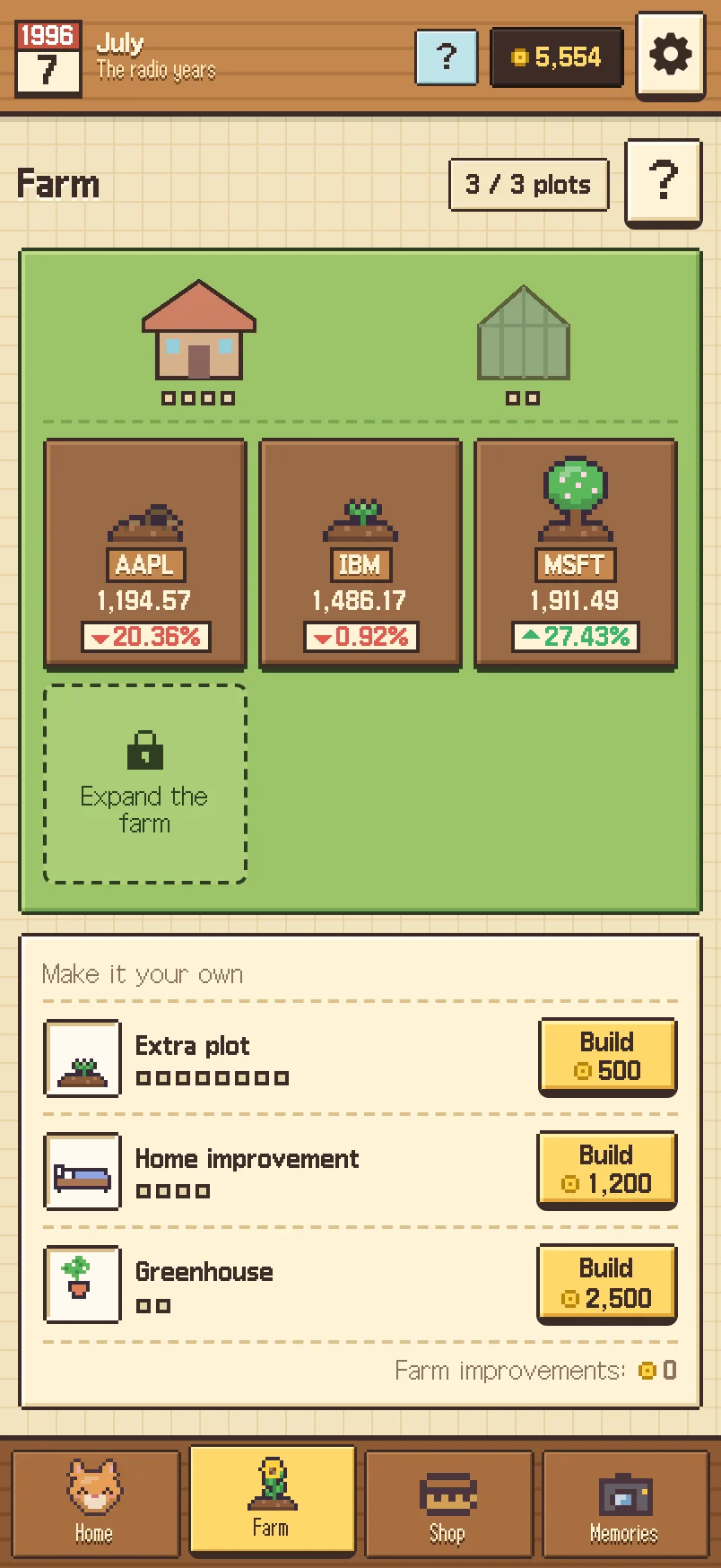
In StockPets a turn is one month, so it helps to think in rates per turn. The rule of 72 works the same way with monthly rates: a crop growing 1% a month doubles in about 70 turns (72 ÷ 1 = 72; the exact answer is 69.7) — just under six years of calendar pages.
Harvesting is where compounding shows up in the game. Coins you harvest can be planted again, so gains can earn gains of their own. But harvest profit also pays for your pet’s monthly wishes, extra plots and home upgrades. Spending some of it is part of the fun; it simply means that part stops compounding. The full rules are in how to play.
- Prices are historical monthly closes, so no crop grows at a steady rate.
- Cash dividends aren’t paid, so real-world total returns would compound faster than game prices — see price return vs total return.
- Your pet’s grown look reflects how its generation’s crops did, so a long, patient stretch becomes visible — see how your pet grows.
Sources and calculation notes
The worked examples on this page are original calculations using the stated hypothetical values.
Frequently asked questions
What is the rule of 72?
A shortcut: divide 72 by an annual rate in percent to estimate how many years something growing at that rate takes to double.
How accurate is the rule of 72?
Within about 0.1 year for rates between 6% and 10% (at 8% it gives 9 years versus 9.01 exact). It drifts further at very low and very high rates.
What is the exact formula for doubling time?
Years = ln 2 ÷ ln(1 + r), with r written as a decimal. At 6%, that is 0.6931 ÷ 0.0583 ≈ 11.9 years.
Can I use the rule of 72 for stocks?
Only as a rough guide, and with a compound average rate. Stock returns change from year to year and can be negative, so actual doubling times are uncertain and never guaranteed.
Does the rule of 72 work with monthly rates?
Yes, and the answer comes out in months. Growth of 1% a month doubles in about 70 months.
StockPets is a game that uses virtual coins only. Nothing on this page is investment advice, and past price changes do not predict future results.