 StockPets
STORIES FROM THE FARM
Why a 50% stock loss needs a 100% gain to recover
· The StockPets team
A fall of 50% followed by a rise of 50% feels symmetrical. The arithmetic is not. The rise starts from a smaller amount, so the same percentage applies to fewer coins. This small distinction explains a lot of apparently puzzling recovery charts.
Short answer
After a loss of L%, the gain needed to regain the starting value is L ÷ (100 − L) × 100%. A 50% fall takes 100 to 50; a 100% rise takes 50 back to 100. This assumes no additional deposits, withdrawals, dividends, fees or tax, and it does not say whether or when a recovery will happen.
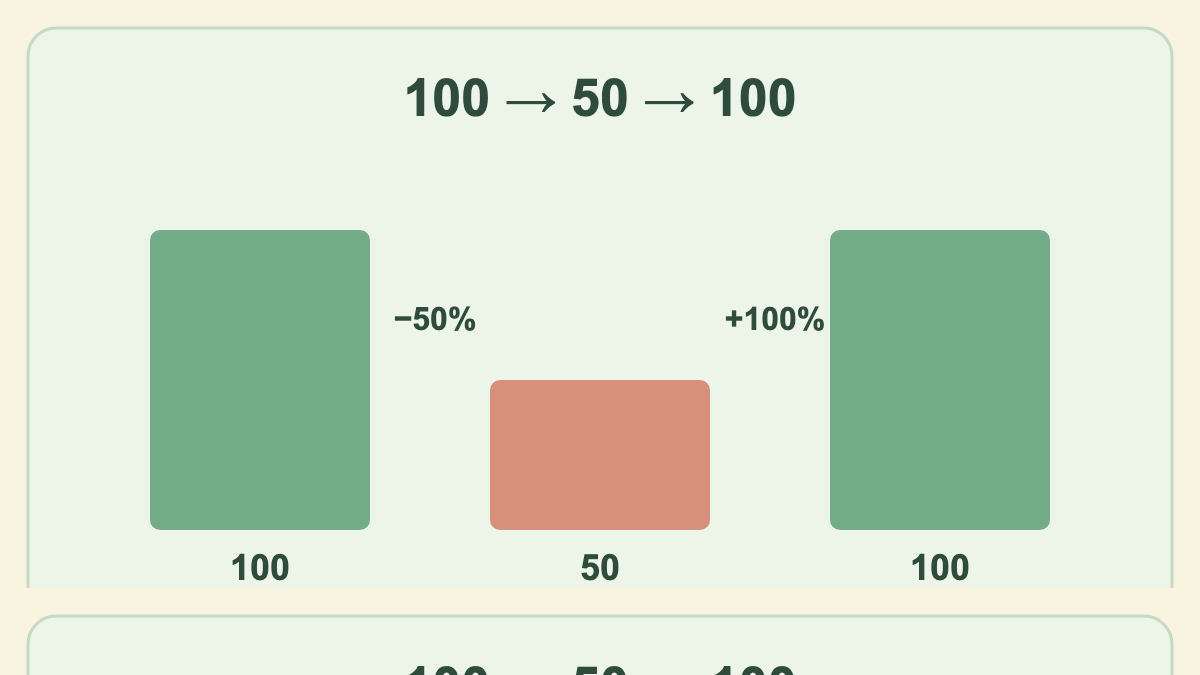
The formula follows from the smaller starting point
Start with 100 units of value. After losing L%, 100 − L remains. The missing amount is L, so the required gain relative to what remains is L ÷ (100 − L). Multiply by 100 to express it as a percentage. The calculation applies to losses below 100%; after a complete loss, a percentage rise from zero cannot restore the original value.
| Loss | Value left from 100 | Gain needed to return to 100 |
|---|---|---|
| 10% | 90 | 11.11% |
| 20% | 80 | 25% |
| 30% | 70 | 42.86% |
| 40% | 60 | 66.67% |
| 50% | 50 | 100% |
| 80% | 20 | 400% |
Why minus 20% plus 20% still leaves a loss
100 × 0.8 × 1.2 = 96. The first move loses 20, but the second adds only 16 because it starts from 80. Returns multiply across periods; adding the percentages would hide the 4% overall loss. The same principle explains why a volatile path can finish below its starting value despite having equal-sized percentage falls and rises.
A recovery threshold is not a recovery timetable
The table contains no information about future prices. A company may recover quickly, remain below its old value for years or never recover. Delisting and missing data also need separate handling. The game’s delisting guide explains its simplified rule; real-world shareholder outcomes depend on the circumstances.
A price getting back to an old high is also different from your account breaking even. If you bought at several prices, harvested part of a position or moved money into another asset, use the actual cash flows and remaining holdings. Inflation can make nominal recovery different from recovery in purchasing power.
Use the calculation during a historical game
- Write down one crop’s starting value and quantity before advancing a month.
- After a fall, calculate the percentage gain needed from its current value using the formula.
- Advance through later months without assuming the old high will return on a schedule.
- Keep crop-price recovery separate from total farm value, remaining cash, care spending and harvests.
The 2008 replay and 2022 replay provide historical context. The worked table above is general arithmetic, not a screenshot-based measurement of either period or a promise about a specific seed.
Sources and calculation notes
The worked examples on this page are original calculations using the stated hypothetical values.
Frequently asked questions
What gain is needed after a 20% loss?
25%. A starting value of 100 falls to 80, and 20 ÷ 80 = 25%.
What gain is needed after an 80% loss?
400%. A starting value of 100 falls to 20; adding the missing 80 requires a gain four times the remaining value.
Does a 50% rise offset a 50% fall?
No. 100 falls to 50 and then rises to 75. A 100% rise from 50 is required to get back to 100.
Does the formula predict how long recovery takes?
No. It calculates a required percentage, without estimating future prices or a recovery date.
What happens after a 100% loss?
The remaining value is zero. A percentage increase on zero cannot recover the original amount; new value would have to enter through some other mechanism.
StockPets is a game that uses virtual coins only. Nothing on this page is investment advice, and past price changes do not predict future results.