 StockPets
STORIES FROM THE FARM
Dollar-cost averaging vs lump sum: compare the same starting budget
· The StockPets team
Buying gradually sounds reassuring when the next market move is unknown. Yet ‘gradually’ changes how much money is exposed at each point. A useful comparison starts with the same money available on the same day and includes the cash that has not been invested.
Short answer
Dollar-cost averaging commits equal amounts at regular intervals; a lump sum commits the available budget at once. Neither wins on every price path. With three hypothetical prices of 100, 50 and 100, investing 100 at each step ends at 400, while investing all 300 at the first step ends at 300. The example excludes dividends, cash interest, fees and tax.
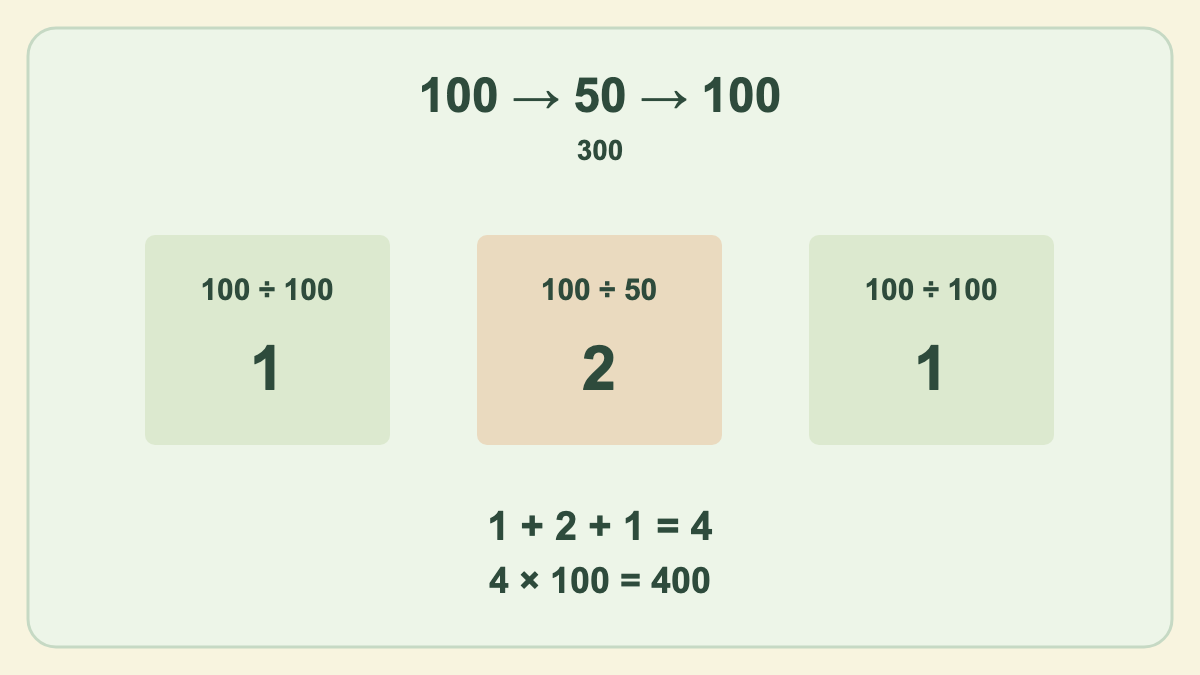
A transparent example with a 300-coin budget
The following prices are invented for arithmetic, not taken from a company or an actual StockPets journey. Both approaches start with 300 coins. The staged approach buys at the displayed price in each of three periods; all holdings are valued immediately after the third purchase.
| Period | Hypothetical price | Staged purchase | Units acquired |
|---|---|---|---|
| 1 | 100 | 100 | 1 |
| 2 | 50 | 100 | 2 |
| 3 | 100 | 100 | 1 |
| Total | Final price: 100 | 300 | 4 |
The staged approach owns 4 units, worth 400 coins at the final price of 100. Its average purchase price is 300 ÷ 4 = 75. The lump sum buys 3 units at 100 and ends at 300. During the first two periods, the staged approach also holds uninvested cash; that cash belongs in any interim portfolio comparison.
Change the path and the winner changes
Now use prices of 100, 150 and 200. Staged purchases buy 1 + 2/3 + 1/2 units, worth about 433.33 at 200. Buying all 300 at the beginning buys 3 units, worth 600. These two examples show why a result depends on the path and exposure time. They do not estimate how often either path occurs.
Available savings and future earnings are different comparisons
Spreading money that is already available delays exposure. Investing money as it is earned is a different situation: money from a future pay cheque could not have been invested at the original date. Do not compare those two situations as if their starting resources were identical. Investor.gov defines dollar-cost averaging as regular, equal purchases regardless of price moves.
How to explore staged planting in StockPets
- Choose a starting virtual budget and write down how much you will keep as cash.
- Choose a seed available in that game month and a fixed number of monthly steps.
- Use manual purchases from your remaining virtual balance at the chosen steps. StockPets does not offer an automatic investment plan or a recurring real-money deposit.
- Compare the value of crops plus cash, and record any harvests or spending on game items. Changing those flows changes the experiment.
Buying more of a crop that keeps falling can still lose money. Use the loss-recovery calculation to separate a lower average purchase price from actually recovering the total amount spent. The price-data guide explains why the game’s series is not a dividend-reinvested return.
Sources and calculation notes
The worked examples on this page are original calculations using the stated hypothetical values.
Frequently asked questions
Does buying gradually guarantee a profit?
No. More units at a lower price can still be worth less than the money spent if the price keeps falling.
How do I calculate the average purchase price?
Divide the total amount spent by the total number of units acquired. Averaging the displayed prices is not generally correct for equal-money purchases.
Should unused cash count in the comparison?
Yes. Include remaining cash in portfolio value and state whether it earns interest. This example assumes zero cash interest.
Can I set automatic monthly purchases in StockPets?
No automatic investment schedule is described here. You can manually buy more with the virtual coins already available in your journey.
Which approach always wins?
Neither always wins. The two worked price paths produce different outcomes because they expose the budget at different times.
StockPets is a game that uses virtual coins only. Nothing on this page is investment advice, and past price changes do not predict future results.