 StockPets
STORIES FROM THE FARM
Survivorship bias: why today’s S&P 500 can distort the past
· The StockPets team · Updated
Put the 30-year charts of familiar companies side by side and holding on looks surprisingly easy. The missing names are harder to spot. Open an old StockPets seed list and those empty spaces become part of the story.
Short answer
Survivorship bias means judging the whole picture using only the examples that survived, while leaving out those that disappeared. StockPets introduces seeds using historical index membership rather than moving today’s company list back into the past, so you meet choices a list of eventual survivors would hide.
 ···
 ···

The bullet holes on the bombers that came back
During World War II, statistician Abraham Wald studied how to estimate aircraft vulnerability from damage to planes that returned. The familiar bomber story illustrates the problem: a heavily damaged area might be somewhere a plane could be hit and still make it home. Before calling an unmarked area safe, ask whether planes hit there failed to return. The CNA reprint of Wald’s original work starts with observations from surviving aircraft.
The observations are real. The problem is what never reached the sample. That same question applies to success stories and stock charts: who is missing from the picture?
What happens if you backtest 1996 with today’s S&P 500?
A backtest applies a selection or trading rule to historical data. If you start by choosing today’s S&P 500 companies and then look up their 1996 prices, your starting list already contains information from the future. You may include companies before they joined the index and leave out ones that later exited or disappeared.
Being publicly traded in a particular year is different from belonging to the S&P 500 that year. An old price chart does not establish historical index membership. For a playable example of the gap between remembering a famous company and being able to choose it, read replaying the dot-com bubble.
How StockPets keeps later names out of earlier shops
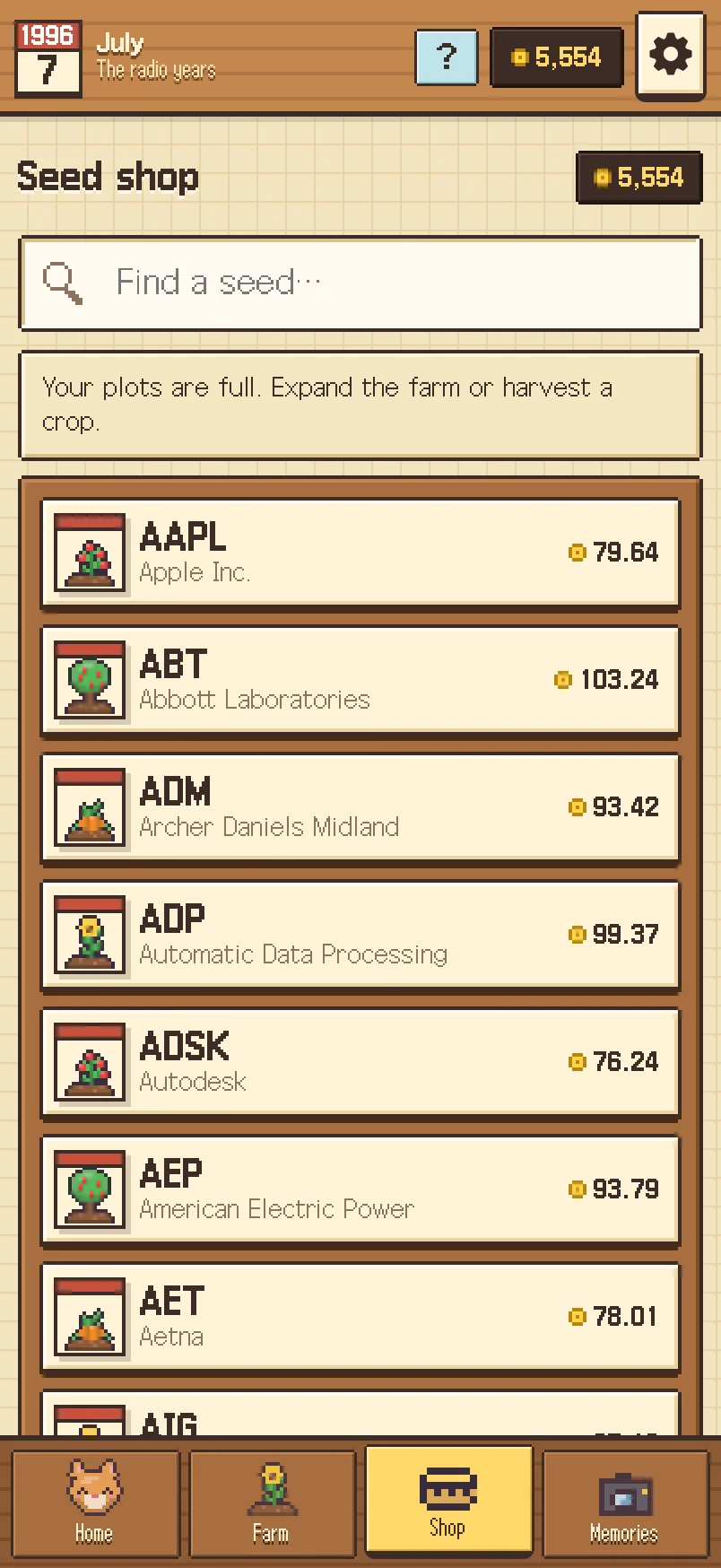
- Seeds arrive from their recorded entry month. Historical S&P 500 membership and available price data determine when a seed appears. A later entrant is not placed in the 1996 shop in advance.
- Leaving the index does not end trading. A company can leave the S&P 500 while its seed remains available to hold, buy and sell, provided the game still has prices and no delisting has occurred.
- Delisting reduces a crop’s value to zero. The game applies this rule to merger-related delistings too. It does not reproduce the acquisition payment a real shareholder might receive.
If an individual company’s price records simply end earlier, a separate rule harvests the crop at its last recorded price. Keeping that apart from a delisting matters when reading the numbers below. The delisting guide explains the distinction.
Thirty years in the game data: what happened to the first 229 seeds?
In the StockPets game dataset, 229 seeds are available from January 1996. Tracking those seeds through September 2026 gives four mutually exclusive outcomes.
| Status in September 2026 | Seeds | Share of the original 229 |
|---|---|---|
| Delisted; crop value reduced to zero | 37 | 16.16% |
| Individual price history ended; automatically harvested | 5 | 2.18% |
| Outside the index, still tradable | 41 | 17.90% |
| Still in the index and tradable | 146 | 63.76% |
How much does choosing only the survivors change the result?
Give each basket the same 10,000 virtual coins in January 1996, divided equally by company. One basket includes only the 187 seeds still tradable in September 2026; the other includes all 229 starting seeds. There is no reinvestment or rebalancing. The 37 delisted seeds end at zero, while the five data-end seeds are harvested at their final recorded prices and the coins are held.
| How the starting list is chosen | Value in September 2026 | Change from the start |
|---|---|---|
| Select only the 187 seeds still tradable at the end | About 217,345 coins | +2,073.45% |
| Include all 229 seeds available at the time | About 177,640 coins | +1,676.40% |
Selecting the eventual survivors in advance makes the final value look 22.35% higher. Subtracting the returns gives a gap of 397.04 percentage points. The 187 survivors are not just the 2026 index members: they include 41 companies that left the index but remained tradable in the game data.
The question that stays with you
When an unfamiliar name turns up in the shop, pause before passing it by. Is it unfamiliar because it was small then, or because it did not make it into the present? A chart built only from famous survivors rarely makes you ask that.
StockPets does not reconstruct every historical choice perfectly. But watching lists change, names disappear and former index members stay in your field makes “you just had to hold on” feel less complete. For the way historical prices become game coins, see the stock splits and adjusted prices guide.
Frequently asked questions
What is survivorship bias in simple terms?
It is judging a whole group using only the examples that remain, while overlooking those that disappeared. In stocks, calculating past performance using only companies still trading today is a familiar example.
Why can today’s S&P 500 constituents distort a backtest?
Choosing current constituents already uses future information. Adding companies before they joined, or omitting companies that later left or were delisted, changes the choices available at the historical starting date.
Does leaving the S&P 500 make a StockPets crop die?
No. Index removal alone does not kill a crop. A seed can remain tradable while its game price history continues and it has not been delisted. Delisting, including through a merger, is a separate game rule that sets crop value to zero.
Were all 42 starting seeds with an end date delisted?
No. In the StockPets game data, 37 are reduced to zero under the delisting rule. The other five have shorter price records and are automatically harvested at the last recorded price. They are not counted as the same outcome.
Are these actual S&P 500 investment returns?
No. This compares a game-specific starting list of 229 companies, not all historical index constituents. Dividends, taxes and fees are excluded. Coins are virtual and cannot be exchanged for cash. This is not investment advice or a stock recommendation, and past outcomes do not predict future results.
StockPets is a game that uses virtual coins only. Nothing on this page is investment advice, and past price changes do not predict future results.