 StockPets
STORIES FROM THE FARM
How to choose a stock market simulator as a beginner
· The StockPets team
A simulator can make a market decision feel concrete before any real money is involved. But an order-entry practice account, a historical replay and a pet-and-farm game answer different questions. Start by choosing what you want to learn, then check what the tool leaves out.
Short answer
Choose a stock simulator by its purpose, data and limitations. Use paper trading to explore an order workflow, a historical replay to experience a past market cycle, or a backtest to compare a fixed rule. StockPets offers a historical pet-and-farm game with virtual coins and monthly turns; it does not simulate a brokerage account or predict future returns.

Which kind of simulation fits your question?
| Your question | Useful format | What to check |
|---|---|---|
| How does placing an order work? | Paper trading | Order types, delays and fill assumptions |
| Could I stay with a decision through a crash? | Historical replay | Start date, missing companies and time step |
| How did one fixed rule behave? | Backtest | Cash flows, costs, dividends and selection bias |
The label ‘simulator’ alone does not tell you how prices or transactions work. A price displayed on a screen is not necessarily the price at which a real order could be filled. Ask whether the result depends on hindsight, frictionless trading or a list of companies selected after the fact.
A five-point checklist before you start
- Choose one learning question, such as comparing a single purchase with a staged purchase.
- Identify the price frequency: live, delayed, daily or monthly. A monthly game cannot test an intraday trading rule.
- Check whether dividends, fees, tax and unavailable prices are represented.
- Check whether failed or delisted companies remain in the data. Removing them can make the past look easier.
- Write down a decision rule before seeing the next result. Record why you would continue or change it.
What you can explore in StockPets
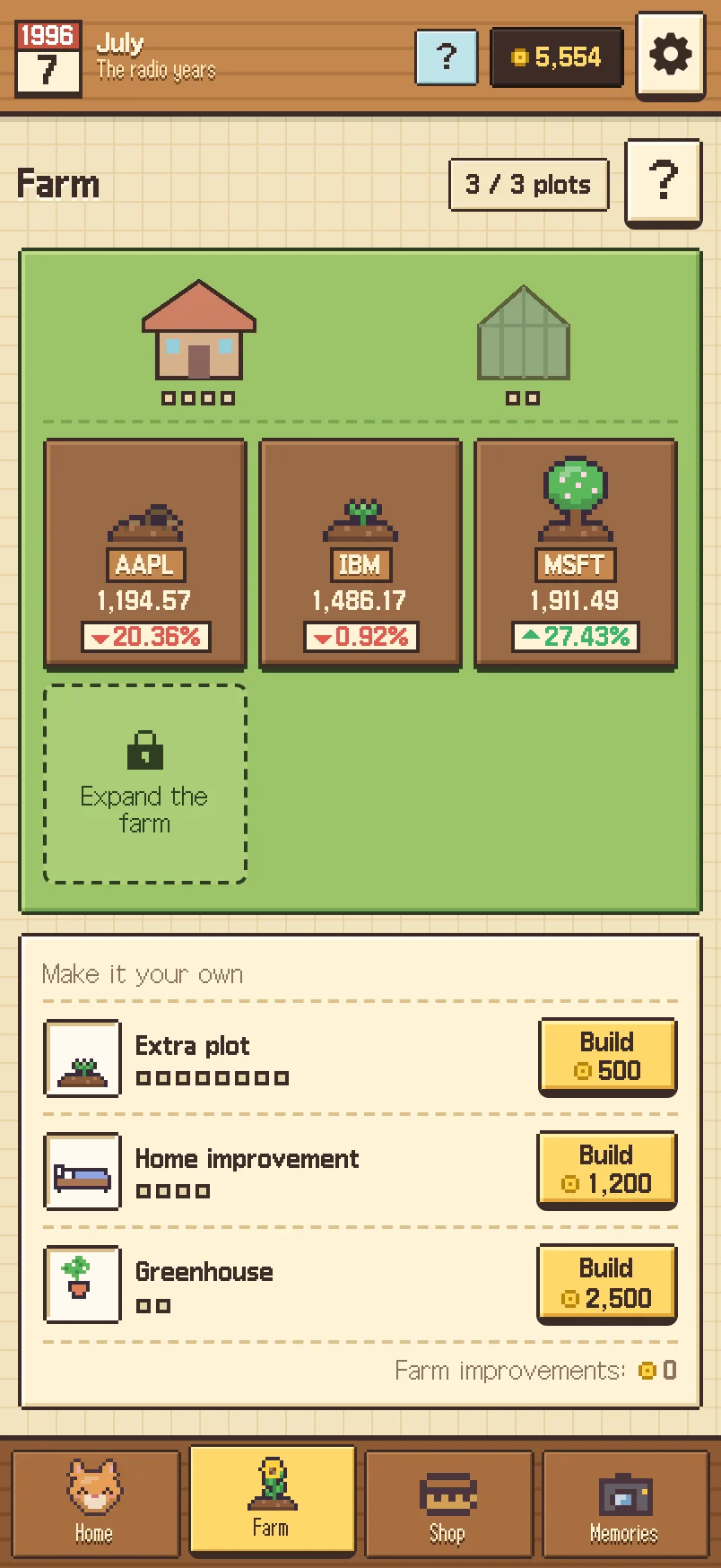
A journey begins in January 1996 with a pet and 10,000 virtual coins. Seeds follow historical US stock price changes one month at a time. Planting and harvesting turn an abstract allocation into a small farm you can revisit. The first-year guide explains the actual controls and calendar rules.
This makes it useful for noticing patience, concentration and the discomfort of a falling crop. It is less useful for learning order books, brokerage settlement or the emotional consequences of losing your own money. Read the comparison with paper trading when choosing between those experiences.
Try one small experiment and keep a decision diary
Pick a fixed virtual budget, a starting month and one rule. For example, commit half now and leave half as cash until a later month. Before advancing, write what you expect and what would make you change your mind. Afterwards, compare your written plan with what you actually wanted to do. Keep the cash and the invested portion in the comparison.
For a more structured next step, use the staged-versus-single-purchase example. A successful game result is a result under that game’s assumptions, rather than evidence that the same decision will work in a real account.
Frequently asked questions
Can I practise without real money?
Yes. StockPets uses virtual coins. There is no brokerage order or cash withdrawal attached to a crop.
Is a historical game the same as paper trading?
No. Historical replay advances through a past price series. Paper trading usually practises transactions against current or delayed market prices.
Can a simulator tell me which stock to buy?
A result can illustrate an assumption or a past outcome. It cannot establish which company will perform best in the future.
What should I record in a practice diary?
Record the starting budget, date, decision rule, remaining cash and why you made each decision before seeing the next result.
Does StockPets teach intraday trading?
No. Its historical price progression is monthly and its actions are game planting and harvesting, rather than exchange orders.
StockPets is a game that uses virtual coins only. Nothing on this page is investment advice, and past price changes do not predict future results.