 StockPets
STORIES FROM THE FARM
Does owning more stocks always mean better diversification?
· The StockPets team
Three crops can make a farm look varied while all three depend on the same kind of business. Counting positions is only the first step. The more useful question is what could make them fall at the same time, and how much of the budget each position carries.
Short answer
Diversification spreads exposure across investments with different risks; adding more names does not automatically achieve it. It can reduce dependence on one company, but cannot guarantee a profit or prevent a broad market loss. StockPets lets you explore concentrated and mixed virtual farms, while a few game plots are not a diversified real-world portfolio.
Separate company risk from shared market risk
An unexpected problem at one company is different from a shock affecting many businesses. Several firms may share customers, funding conditions or a technology cycle. They can move together even if their names and products differ. Investor.gov’s diversification definition describes spreading investments to reduce risk; it is not a guarantee against loss.
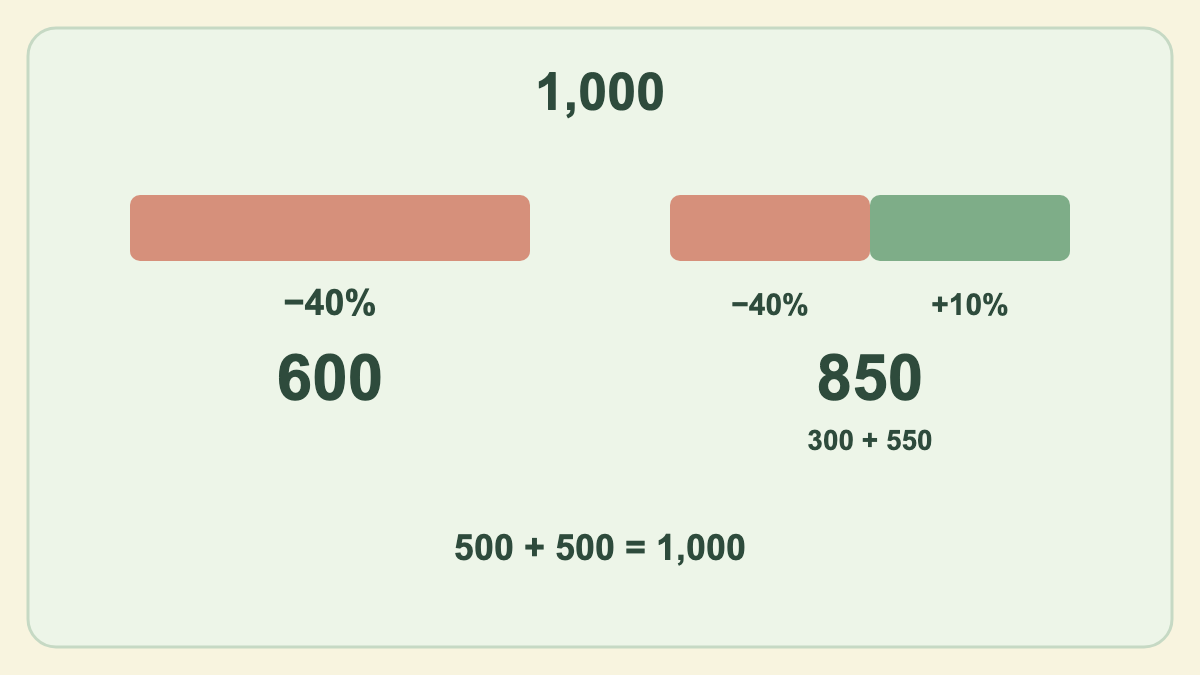
Two hypothetical portfolios with the same 1,000 coins
| Allocation | Hypothetical returns | Final value |
|---|---|---|
| 1,000 in A | A: −40% | 600 |
| 500 in A; 500 in B | A: −40%; B: +10% | 300 + 550 = 850 |
| 500 in A; 500 in B | A: −40%; B: −40% | 300 + 300 = 600 |
The mixed allocation softens the loss only in the example where B behaves differently. When both fall by 40%, splitting the budget does not change the result. These are invented returns for explanation; they are not selected historical companies or a backtest of the game.
Weights matter more than the number of names
A farm with 900 coins in A and 100 in B remains mostly exposed to A. If A loses 40% and B gains 10%, it ends at 540 + 110 = 650, a 35% loss. The starting-weight calculation is 0.9 × (−40%) + 0.1 × 10% = −35%, assuming no cash flows or trades during the period. Rebalancing later introduces another decision and, in real accounts, potentially costs and tax.
A useful farm experiment has a written rule
- Choose a small virtual budget and decide the weights before seeing the next month.
- Compare one-company exposure with several available seeds, leaving the same total cash allocation in each comparison.
- Record why you think the businesses might behave differently, rather than just choosing different crop pictures.
- Include remaining cash, harvests and game spending when reviewing the farm’s total value.
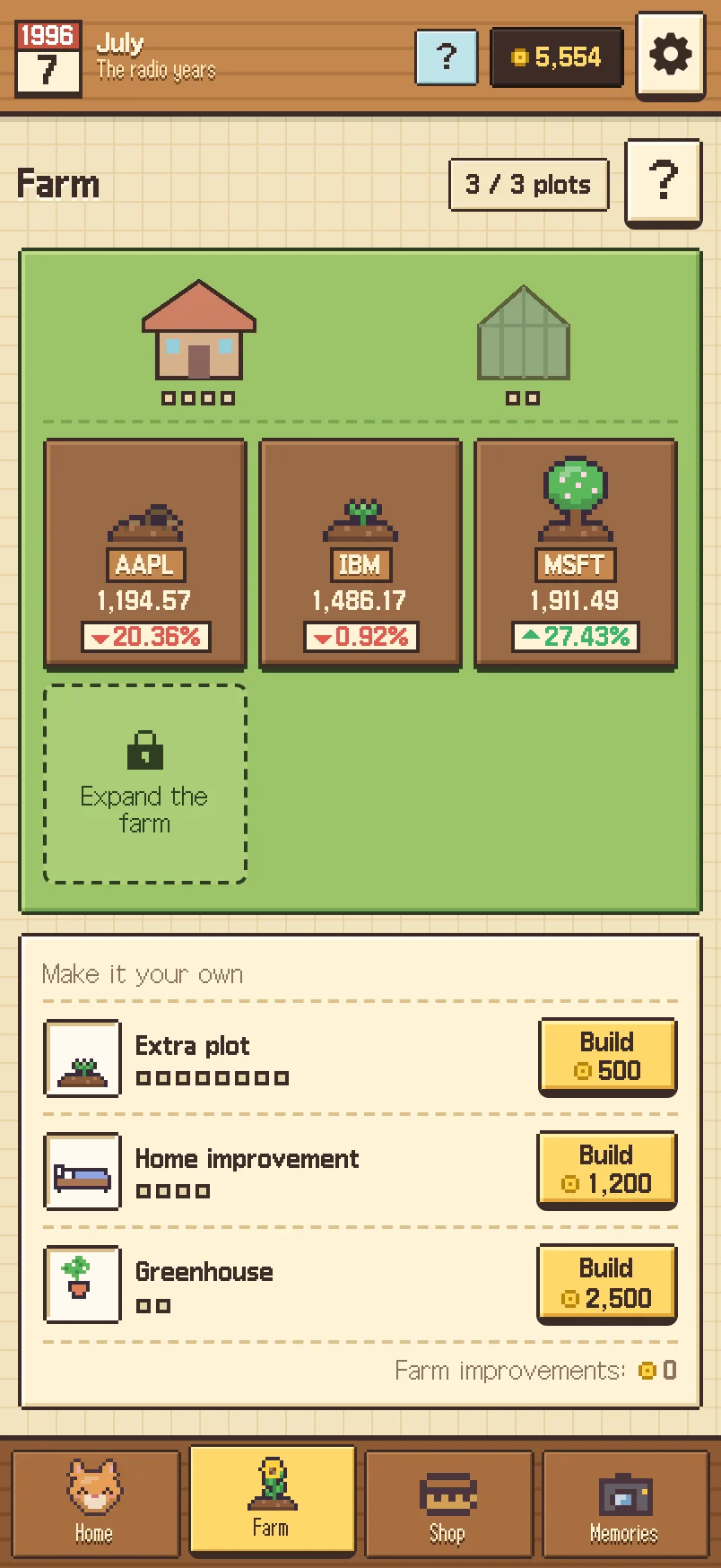
The initial three plots in StockPets are a game constraint. They do not prescribe how many stocks a person should hold, and the game is not an ETF or multi-asset portfolio simulator. Check the planting guide for the actual rules and the survivorship-bias article for the effect of which companies enter a comparison.
Diversification does not remove the need to understand the data
A broad index and a handpicked group of winners answer different questions. Historical membership changes, unavailable price series and delisting rules can all affect a result. The index additions and removals article explains why an index is not a fixed list of companies forever.
Sources and calculation notes
The worked examples on this page are original calculations using the stated hypothetical values.
Frequently asked questions
Are three different stocks automatically diversified?
No. They may share a sector or other common risks, and three holdings are not the same as a broad multi-asset portfolio.
Can diversification prevent every loss?
No. Several investments can fall together during a market-wide shock.
Why do portfolio weights matter?
A position with 90% of the starting budget has much more influence than one with 10%, even though each counts as one holding.
Do crop pictures identify different economic sectors?
No. A game illustration is not evidence about a company’s sector, correlation or risk.
Is a StockPets farm an S&P 500 index fund?
No. You select available individual seeds under game rules. The farm does not automatically hold and rebalance the full index.
StockPets is a game that uses virtual coins only. Nothing on this page is investment advice, and past price changes do not predict future results.