 StockPets
STORIES FROM THE FARM
How Do Stocks Get Added to (and Removed From) the S&P 500?
· The StockPets team · Updated
The S&P 500 gets described as “America’s 500 leading companies,” but the list never stands still. Every year, companies join and others leave. Knowing who decides, on what basis, and what happens to the companies that drop out changes how you read an index chart.
Short answer
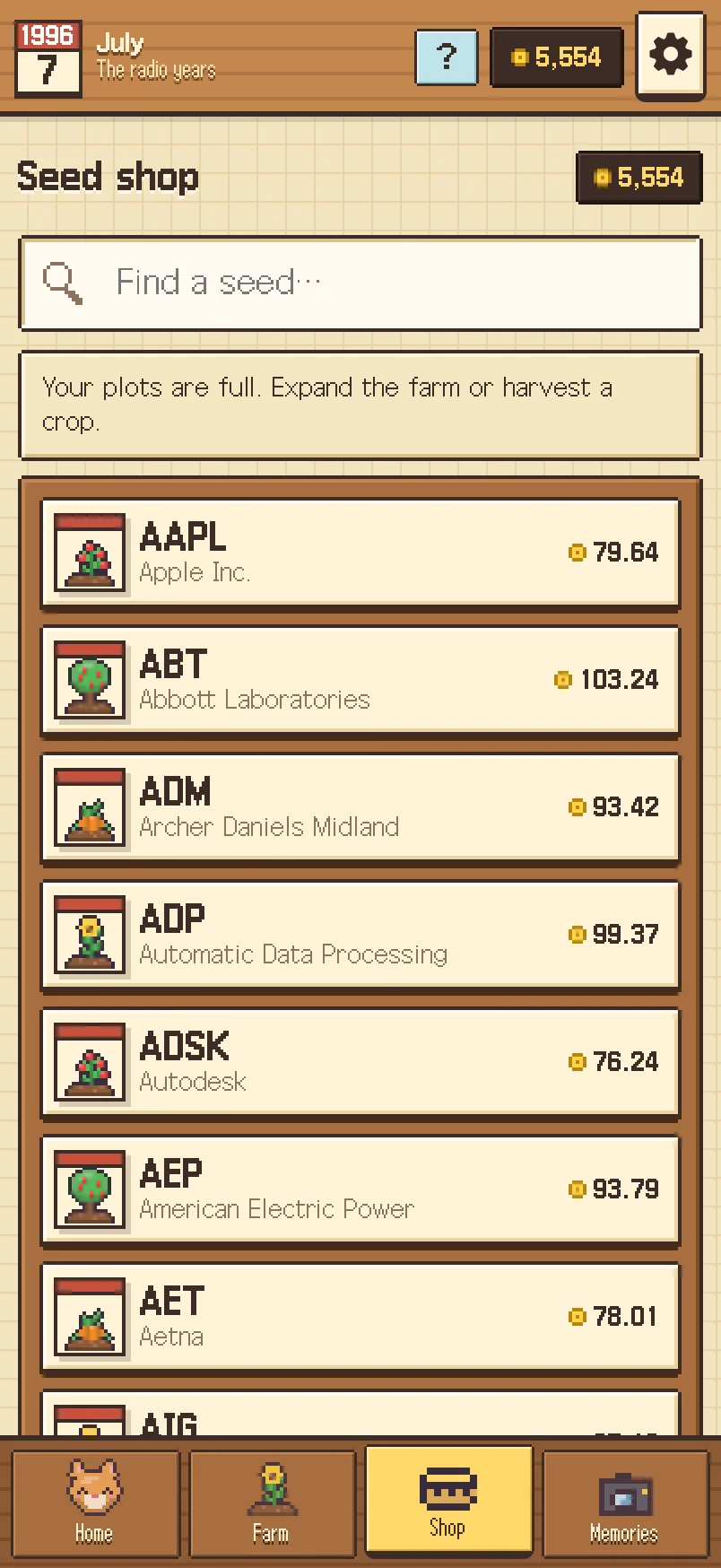
Additions to the S&P 500 are decided by the S&P Dow Jones Indices Index Committee. Under the July 2026 methodology, a company must be US-domiciled, have a market cap of at least $22.7 billion, show positive GAAP earnings for the latest quarter and the last four quarters combined, and trade actively. Being removed doesn’t make a company disappear, and its shares usually keep trading. The StockPets seed shop follows this history, showing each seed from the month its company joined the index.
 ···
 ···

Who decides what’s in the S&P 500?
The S&P 500 is run by S&P Dow Jones Indices. Additions and removals aren’t made by an automatic formula but by an Index Committee of full-time staff, which meets monthly to review corporate actions, index statistics, candidates and market conditions. The rules are public, but the final call involves the committee’s judgment.
That’s why the S&P 500 isn’t simply the 500 biggest US companies by market value. The committee picks among eligible companies while also weighing things like sector balance, so a company can be large and still be waiting to get in.
S&P 500 inclusion criteria (July 2026 methodology)
| Requirement | What it means |
|---|---|
| Domicile | A US company |
| Exchange | Listed on an eligible US exchange such as NYSE or Nasdaq; OTC markets don’t qualify |
| Market cap | $22.7 billion or more for the company, with float-adjusted value at least half of that |
| Public float | Investable weight factor (IWF) of at least 0.1 |
| Liquidity | Float-adjusted liquidity ratio of at least 0.75, and at least 250,000 shares traded in each of the last six months |
| Financial viability | Positive GAAP net income for the latest quarter and for the last four quarters combined |
When are companies removed?
- Mergers and acquisitions. When a company is bought or merges, it usually leaves the index when its shares stop trading. This is the most common reason.
- Falling far outside the rules. A company that shrinks a lot or substantially breaks other criteria can be removed at the committee’s discretion.
- Making room. When a company comes in, another goes out. Companies that have shrunk often move to the S&P MidCap 400 or SmallCap 600.
One subtlety: the entry rules aren’t staying rules. A current member isn’t dropped just because it briefly misses a criterion. Changes are usually announced at least three business days in advance, at 5:15 p.m. US Eastern Time.
A real example: when did Tesla get in?
Tesla met the profitability test in the summer of 2020 but was passed over in the September quarterly rebalance. Its addition was announced on November 16, and it joined the index before trading on December 21, 2020, the largest addition in the index’s history at the time. It shows that meeting the criteria and actually being added are two different things.
When a stock moves right after its addition is announced, people call it the index inclusion effect, because funds that track the index have to buy it. Many studies find that this effect has shrunk over time, though.
Removed doesn’t mean gone
Leaving the index and being delisted are different things. Removal means the company is off this particular list, and its shares usually keep trading on the exchange. Delisting means trading on the exchange ends. In a merger, both can happen at once.
| Removed from the index | Delisted | |
|---|---|---|
| Meaning | Off the index member list | Trading on the exchange ends |
| Shares | Usually keep trading | No longer trade on the exchange |
| StockPets crop | Keep holding and trading | The crop wilts and is worth zero |
In the StockPets game data, 41 of the 229 seeds available in January 1996 had left the index by September 2026 but were still trading. We track them in our survivorship bias article, and the delisting rule is in the delisting guide.
How does the StockPets seed shop follow the list?
- Seeds appear in the month a company joined. If a famous company wasn’t in the index yet, it isn’t in the 1996 shop. Amazon’s seed appears in November 2005, when Amazon joined.
- Removal doesn’t pull a crop from your field. As long as prices continue, you can keep growing, buying and selling it.
- Today’s list is never pushed into the past. So the seed list itself becomes a timeline of how the index changed.


The question you’ll be left with
The month a new name appears in the seed shop is the month that company really joined the S&P 500. Some had already soared by then, and some went sideways for years after. You can follow questions like “if I knew which companies would be added, could I win?” with no real money. For where the journey begins, read What if you went back to 1996?.
Frequently asked questions
What are the S&P 500 inclusion criteria?
Under the July 2026 methodology, a company must be US-domiciled and listed on an eligible US exchange, have a market cap of at least $22.7 billion, show positive GAAP earnings for the latest quarter and the last four quarters combined, and have enough public float and trading volume. The Index Committee makes the final decision.
How often does the S&P 500 change?
There’s no fixed reconstitution date; changes happen as needed. The Index Committee meets monthly, and changes are usually announced at least three business days in advance.
What happens to a stock removed from the S&P 500?
Removal only takes it off the index list, so the shares usually keep trading. Companies that have shrunk often move to the S&P MidCap 400 or SmallCap 600.
Why does the S&P 500 have more than 500 stocks?
Some companies list more than one class of shares, and each class is included. So the index tracks 500 companies but slightly more than 500 stocks.
Can I keep a crop in StockPets after its company leaves the index?
Yes. If prices continue and the company isn’t delisted, you can keep holding and trading it. If it’s delisted, including through a merger, the crop wilts and is worth zero.
StockPets is a game that uses virtual coins only. Nothing on this page is investment advice, and past price changes do not predict future results.